Back to Articles listing
Deep Learning Basics: Explore AI Concepts and Applications
- September 24, 2026
- 4 Minutes
- By - Raj Jaiswal

Deep Learning Basics: Explore AI Concepts and Applications
Artificial Intelligence is revolutionizing how businesses, industries, and digital products work. From voice assistants and recommendation systems to medical image analysis and autonomous technology, AI is helping us tackle the most complex problems. One of the most important technologies involved in this progress is deep learning.
Understanding Deep Learning Basics will help students, professionals, and technology enthusiasts learn more about how AI systems learn from data and make predictions. Unlike traditional programming, in which a developer writes a rule for each situation, deep learning systems can detect patterns in massive amounts of data and improve their performance through training.
This guide provides an overview of Deep Learning Basics, its meaning, usage, concepts, applications, benefits, challenges, and career implications.
What Is Deep Learning?
Deep Learning is a sub-field of Artificial Intelligence and Machine Learning that uses artificial neural networks to learn patterns from data. These artificial neural networks work the same way as neurons in our brains do, but are controlled by mathematical and computational models.
The neural network is the core of Deep Learning Basics. It consists of input, one or more hidden layers and an output layer. A neural network with multiple hidden layers is known as a deep neural network.
For example, if an AI needs to correctly identify if an image contains a car, it can be trained using thousands or millions of labeled images. In training, the system learns features such as shapes, edges, colors, and patterns that help distinguish a car from other objects.How Does Deep Learning Work?
Understanding the workings of deep learning is an important part of Deep Learning Basics. The process generally involves gathering data, preparing it, selecting a model, training the model, checking its performance, and using the model to predict.
The process can be explained in simple steps:
1. Data Collection
Deep learning models require data to learn. The data may include images, text, audio, video, numerical information, or other digital records.
The quality and quantity of training data can significantly affect the performance of the model.2. Data Preparation
Raw data needs to be cleaned and prepared before training. This includes removing errors, organizing data, resizing images, changing text, or handling missing values.3. Model Training
The data is given to a neural network, which makes predictions and compares them with expected results.
In the event that the prediction is incorrect, the model adjusts its own parameters to reduce the error. This process is repeated several times.4. Model Evaluation
After training, the model is tested with data that it has not yet seen in order to test for learning useful patterns rather than just remembering the training examples.5. Prediction
Once a model is trained well, we can apply the model to new data. For example, a trained model for image recognition can examine a new image and identify objects in it.

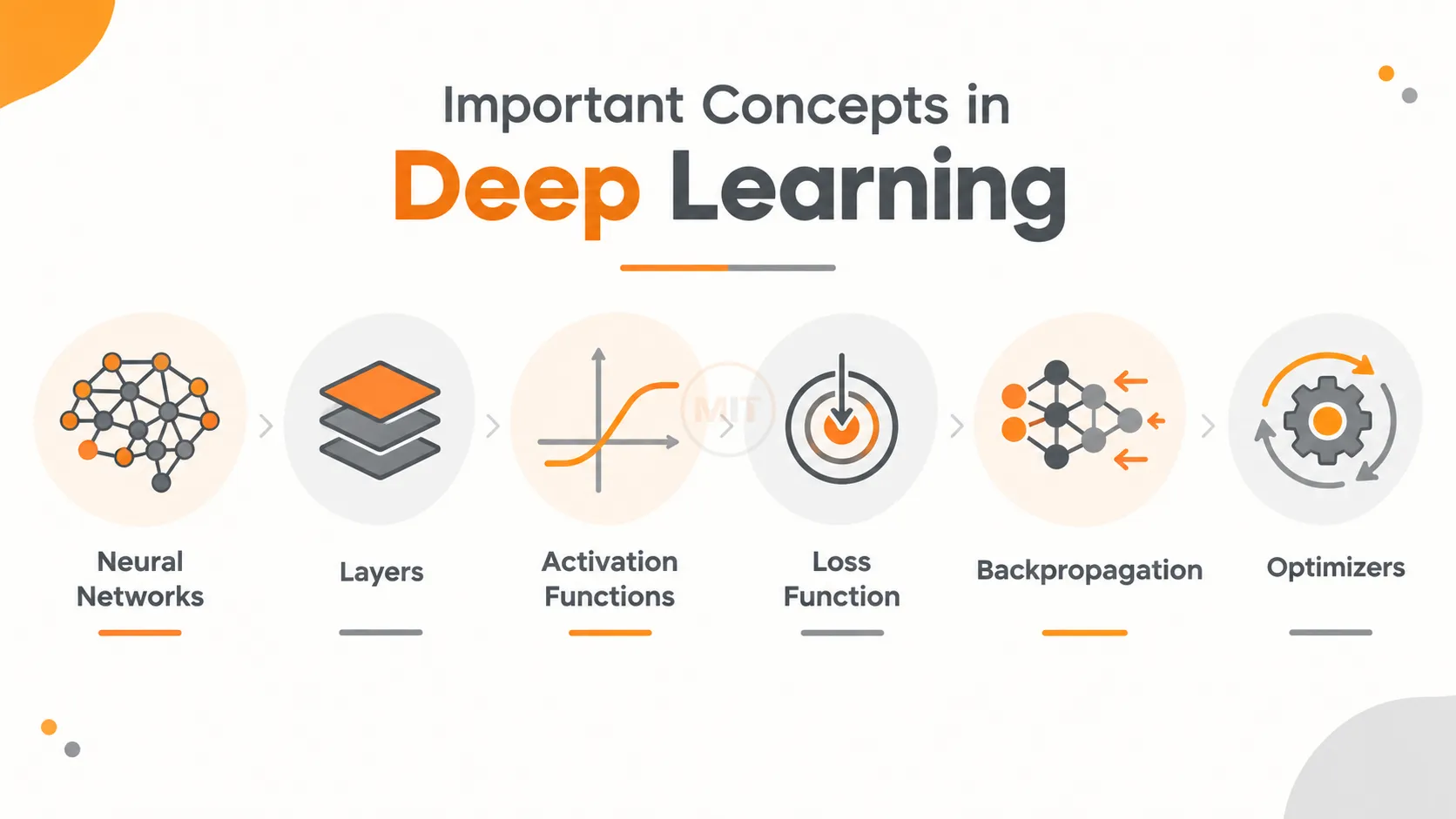
Important Concepts in Deep Learning
Deep Learning Basics consists of several technical concepts.Neural Networks
Neural networks are computational models made up of interconnected nodes called neurons, which receive information and provide an output based on learned parameters.Layers
Neural networks are split into layers – the input layer receives data, the hidden layers process information, and the output layer produces the prediction.
Deep networks contain many hidden layers, allowing them to learn ever more complex patterns.Activation Functions
Activation functions control how information is passed through the neurons, examples of activation functions are ReLU, sigmoid, and softmax.
These neuronal networks learn nonlinear relationships in data.Loss Function
The loss function measures the difference between what the model predicted and what it achieved. In training, the model tries to decrease the loss.Backpropagation
Backpropagation is one of the most important learning methods in neural networks. It is used to understand how much each parameter contributed to the prediction error and to update the model accordingly.Optimizers
Optimizers determine how model parameters are adjusted during training. Ex. Gradient Descent, Adam, and RMSprop.
These ideas are essential concepts to learn Deep Learning Basics because they explain how neural networks improve their predictions.
Types of Neural Networks
Different neural network architectures are designed for different types of problems.Convolutional Neural Networks
Convolutional Neural Networks (CNNs) are widely used in image and visual data analysis. They can help identify pattern such as edges, textures, shapes, and objects.
CNNs are also used in image classification, facial recognition, medical imaging, and computer vision.Recurrent Neural Networks
Recurrent Neural Networks (RNNs) are a type of neural network designed to process data sequentially. They can be used to process text, speech, and time series data.
Modern applications use more advanced architectures for complex sequence processing.Transformers
Transformers have become very important in modern artificial intelligence. They can interpret the relationship among elements of a sequence of data. They are used in language models, translation, text generation, and many other AI applications.
Understanding these architectures will provide the learner with a solid foundation in Deep Learning Basics and help them understand why particular models were chosen for specific problems.Deep Learning Applications
One reason to study Deep Learning Basics is the wide range of applications built using this technology.Healthcare
Deep learning is available to assist with image analysis, disease detection, data analysis, and other healthcare application. It can assist in recognizing patterns in a large number of datasets, although it is important to act as a professional in the medical field.Computer Vision
Deep learning powers many computer vision systems. Applications include object detection, image classification, facial recognition, quality inspection, and video analysis.Natural Language Processing
Deep learning is being used for tasks related to language such as translation, text classification, summarization, speech recognition, and conversational AI.Autonomous Systems
Cars, robots, and other autonomous systems can use deep learning to interpret their environment and make decisions based on sensory information and visual data.Recommendation Systems
Streaming platforms, shopping websites, and other digital services can use machine learning and deep learning to learn from the behavior of users and suggest personalized content.Cybersecurity
Deep learning can help identify unusual patterns or potential threats by analyzing large amounts of network and system data. These applications show the use of Deep Learning Basics in a practical AI solution.Benefits of Deep Learning
Deep learning has many benefits when data, computing power, and model are available.
First, deep learning can learn useful features from complex datasets; there is no need to manually define each feature.
Second, deep learning models can work with all kinds of unstructured information, such as images, sound, and text.
Third, model performances may improve if models are trained on high-quality data and on appropriate architectures.
Lastly, deep learning can provide an opportunity to develop AI applications that cannot be easily constructed using simple rule-based systems.
Deep Learning Basics means looking at the weaknesses of this technology instead of assuming it solves all problems.
Challenges of Deep Learning
Deep learning models require large amounts of training data. It takes time and effort to get reliable and representative data.
Training large models can also require significant computing resources and a high-powered computer for larger scale use may be required.
Another challenge is that some deep learning models may be difficult to interpret, since their decisions are subjected to complex interactions between many parameters.
Data quality is also important. If there are no training data or if the data are not correct, or if the data are biased, or not representative, the model’s results may be unreliable or unfair.
These challenges force AI professionals to understand not just deep learning basics but also data preparation, model evaluation, responsible AI practices, and system limitations.Deep Learning vs Machine Learning
Deep learning is a subset of Machine Learning.
Traditional machine learning relies on a selection of features and set of data manually. Deep learning can learn representations from large and complicated datasets automatically via a series of neural networks layers.
For example, a traditional image classification system may need to identify specific features of images before training a model. A deep learning system can often learn relevant visual features from training images.
Both approaches have their own practical applications and depend on the dataset, problem, resources, accuracy requirements, and application environment.Skills Needed to Learn Deep Learning
Students interested in Deep Learning Basics should have a solid foundation in some areas.
Python is one of the most popular programming languages for AI and machine learning. Students should also know basics in math, statistics, probability, and data handling.
Knowledge of Machine Learning provides an important foundation before going into more advanced concepts of neural networks.
Learners will begin to explore libraries and frameworks like TensorFlow, PyTorch, NumPy, and related data science tools.
Practical projects are especially useful for beginners, such as image classification, sentiment analysis, handwritten digit recognition, or simple prediction models.Why Learn Deep Learning?
AI adoption creating a new opportunities in software development, data science, analytics, automation, computer vision, and other technology areas.
Learning Deep Learning Basics provides the students with the foundation to understand advanced AI systems and to create machine learning projects.
Instead of focusing on the theory only, students should combine concepts with coding, data sets, modeling, evaluation, and real-world problem solving.
A strong training path starts with Python and Machine Learning, and can be followed by neural networks, data preparation, model evaluation, computer vision, natural language processing, and advanced AI architectures.Conclusion
Deep Learning Basics is the first step to understanding how modern AI systems learn from data and recognize patterns. Neural networks, activation functions, loss functions, backpropagation, optimization, and different network architectures all contribute to the development of intelligent applications.
Deep learning has become an integral part of the modern tech landscape. From healthcare, computer vision, natural language processing, recommendation systems, autonomous vehicles, and cybersecurity.
For beginners, the best strategy is to build a solid foundation, practice with real datasets, create projects, and then move on to more advanced AI concepts. Through ongoing learning and practice, Deep Learning Basics can serve as the starting point for exploring a wide range of AI and Machine Learning opportunities.Frequently Asked Questions
1. What are Deep Learning Basics?
Deep Learning Basics covers concepts such as neural networks, layers, activation functions, training, loss functions, backpropagation, and model evaluation.2. Is deep learning difficult for beginners?
Deep learning can include advanced concepts, but beginners can start with Python, basic mathematics, Machine Learning foundations, and simple neural network projects.3. Where is deep learning used?
Deep learning is used in computer vision, natural language processing, healthcare, recommendation systems, robotics, autonomous technologies, and cybersecurity.4. Do I need Python to learn deep learning?
Python is not the only option, but one of the most widely used languages for deep learning due to its libraries, frameworks, and large AI development community.Share this on
-

-

-