Back to Articles listing
Python vs Java: Which Programming Language Should You Learn?
- October 17, 2026
- 4 Minutes
- By - Raj Jaiswal
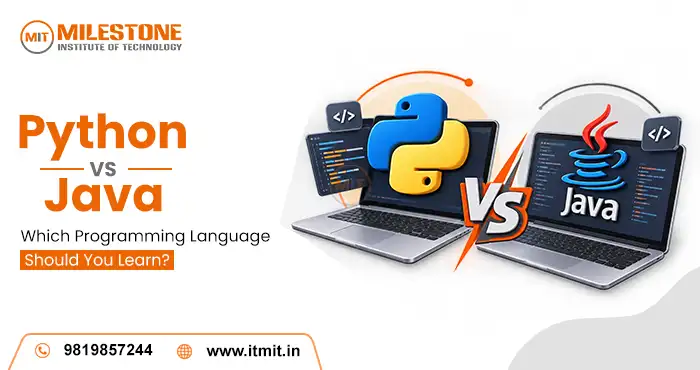
Python vs Java: Which Programming Language Should You Learn?
Choosing the right programming language is a crucial step for anyone who wants to make a career in software development. Python and Java are two popular programming languages used in different industries to help developers create applications, solve problems, and learn technical skills.
If you are still confused about Python vs Java, understanding their differences can help you make a better decision. Learning difficulty, performance, applications, and career opportunities are all important factors to consider before choosing a language.
We’ll explain Python vs Java in simple terms, compare their features, and help you choose the right language for your career goals.What Is Python?
Python is a high level, general purpose programming language known for its simple syntax and readability. Python is very popular with beginners because of its straightforward code.
Python is a widely used programming language for artificial intelligence, machine learning, data science, web development, automation, and data analysis. Python provides many libraries and frameworks that help developers create effective applications.
At the beginning of comparing Python vs Java, those not familiar with the language will likely prefer Python as it is less code-intensive for many common tasks.Simple Python Code Example

Key Features of Python
- Simple and readable syntax.
- Useful libraries for AI and data science.
- Support for automation and web development.
- A large developer community.
Suitable for beginners and experienced programmers.
Python is a good starting point for students who want to learn programming fundamentals and develop practical projects.What Is Java?
Java is a high level object oriented programming language for enterprise software, back end systems, and business applications. It is known for its structured syntax, portability, and mature development environment.
Java programs are generally written in bytecode that runs on the Java Virtual Machine (JVM) and allow Java applications to run on different operating systems.
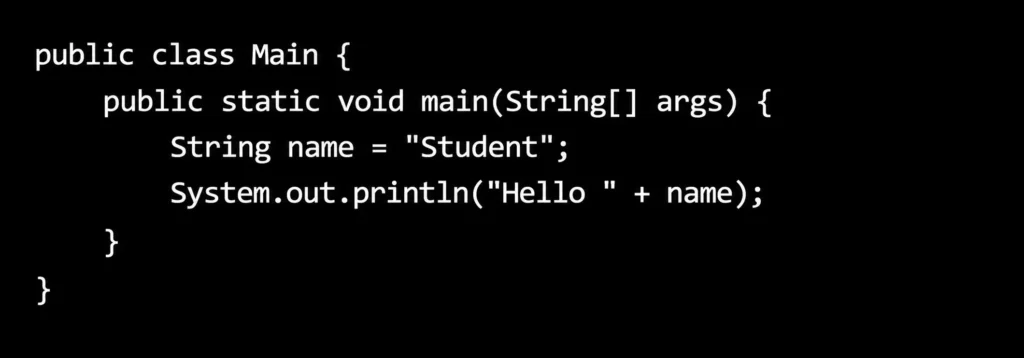
In this Python vs Java comparison, the latter is best used by developers who have large applications that require well-organized code and maintenance.Simple Java Code Example
Key Features of Java
- Supports object oriented programming.
- Runs on compatible systems through the JVM.
- Provides static typing and compile time checks.
- Offers tools for enterprise application development.
- Supports a wide range of libraries and frameworks.
Python vs Java: Key Differences
Understanding the differences between these languages (python vs java) will help you make an informed choice. Both can be used for software development, but they differ in syntax, typing system, and common applications.| Feature | Python | Java |
| Syntax | Simple and concise | Structured and detailed |
| Typing | Dynamically typed | Statically typed |
| Learning difficulty | Generally easier for beginners | Requires learning more structure |
| Execution | Uses a Python runtime | Uses the JVM |
| Performance | Depends on implementation and workload | Often strong for long running applications |
| Main applications | AI, data science, automation | Enterprise software, backend systems |
| Frameworks | Django, Flask, FastAPI | Spring Boot, Jakarta EE |
1. Which Language Is Easier to Learn?
Python is generally easier to use for beginners due to its short syntax. You can easily learn variables, loops, conditions, and functions without writing a great deal of code.
Java requires more structure. A beginning Java programmer needs to understand classes, methods, data types, and object oriented programming concepts. This may take more time at the beginning, but it also helps the student understand how large applications are organized.
When you decide to learn Python vs Java, consider your learning style. If you want a quick introduction to coding, Python is a good choice, while Java is more structured.2. Performance and Execution
Performance is also another important difference between the two languages. In most cases, Java has good performance when it comes to running long-running applications due to the fact that the JVM uses optimization techniques such as Just-In-Time compilation.
Python performance varies depending on the implementation, libraries, and workload. Many Python libraries use optimized native code and are useful for data analysis and numerical computation.
The actual performance depends on algorithms, hardware, database operations, and application design. You should not pick a programming language solely based on the speed of execution.
For beginner coders, understanding the principles of programming and writing efficient code is more important than looking for the slightest performance advantage.3. Career Opportunities in Python and Java
Both languages are very career-focused, but the job role and technology that comes with them may differ.Careers After Learning Python
- Python Developer
- Data Analyst
- Data Scientist
- Machine Learning Engineer
- Automation Developer
- Backend Developer
Careers After Learning Java
- Java Developer
- Backend Developer
- Software Engineer
- Enterprise Application Developer
- Android Developer
- Software Test Automation Engineer
Java is an ideal option for students interested in enterprise, backend engineering, and business software.
Before you decide between Python vs Java, check job descriptions in your desired location to see which frameworks, databases, work experience, and additional technical skills employers are looking for.

4. What Are Python and Java Used For?
Python is widely used in artificial intelligence, machine learning, data science, automation, scientific computing, and web development. Its libraries are used to analyze data, create prototypes, and develop data driven applications.
Java is widely used in banking systems, enterprise applications, back-end services, and large business platforms. Its mature ecosystem supports the development and maintenance of complex software.
When Python is used with Django, the web app is created using Python and Spring Boot.
Both of these languages can be used for developing useful applications. When choosing between Python vs Java, focus on the needs of your project and the area in which you want to work.5. Which Language Should Beginners Choose?
Your career goals should determine which programming language you learn first.Choose Python if you want to:
- Start programming with simple syntax.
- Explore AI and machine learning.
- Learn data analysis and automation.
- Build small projects while learning fundamentals.
Choose Java if you want to:
- Learn structured object oriented programming.
- Develop enterprise applications.
- Explore backend development with Spring Boot.
- Work with Java based business software.
6. Practical Projects to Improve Your Skills
Practical projects help you put programming concepts into practice and develop problem solving skills. You do not need to study only tutorials. Start with small, easy-to-use applications and work up to the more complex ones.
Beginners can make a calculator, an expense tracking tool, a file organizer or a basic data analysis project using Python. Later, they can create web applications or machine learning projects.
Beginner Java developers can develop a student management system, inventory, bank application prototype, or simple REST API.
While learning Python vs Java, focus on troubleshooting, writing clear code, using Git, working with databases, and testing applications. All of these skills are useful for a variety of software development positions.Conclusion
Choosing between these languages becomes easier based on your interests and job goals. Python is a beginner friendly language that is used in AI, data science, and automation. Java is a more structured language of software development that is used in applications for business and backend systems.
The choice between Python vs Java is really dependent on the projects that you intend to develop and your chosen career path. Get back to basics, practice often, and build projects that show your ability.
With the right plan and practice, both languages can give you valuable technical skill set and help you pursue a career in software development.Frequently Asked Questions
1. Is Python better than Java?
Neither is better. Python is great for artificial intelligence and data science, and Java is a standard platform for enterprise software and backend development.2. Can beginner learn Java without Python?
Yes. Beginners can learn Java without any previous programming experience.3. Which language is better for AI development?
Python is preferred due to the extensive collection of libraries available for artificial intelligence and machine learning.4. Can I learn Python and Java simultaneously?
Yes. Start with one language, practice through projects, and then learn the second to further your knowledge.Share this on
-

-

-